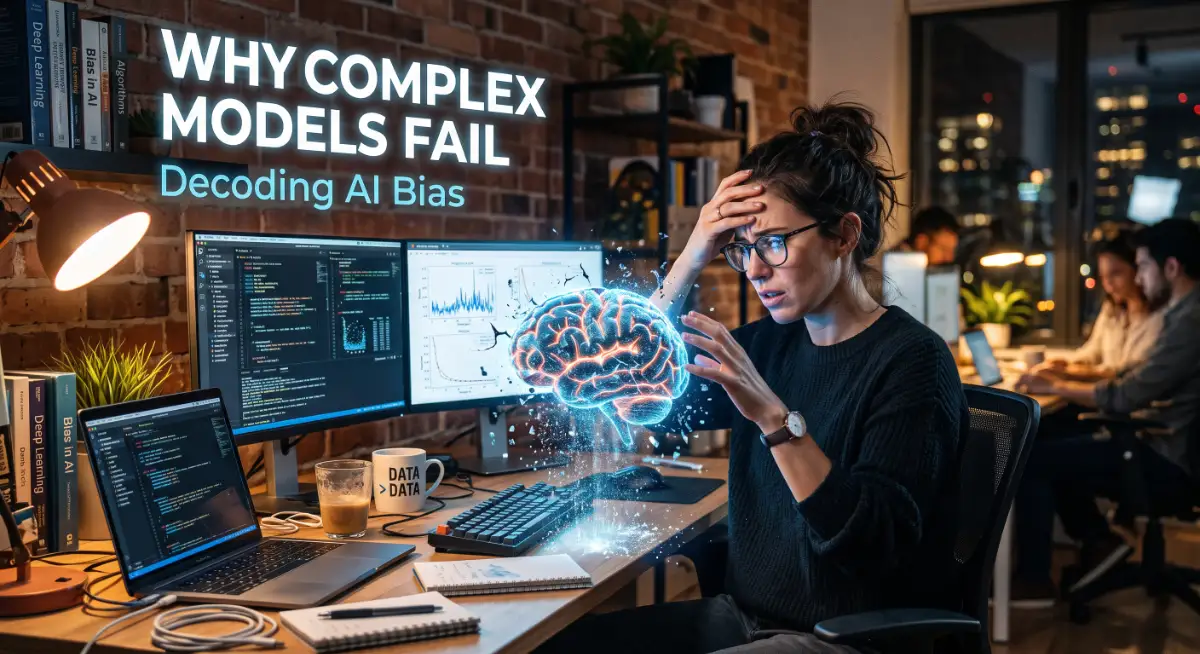
The Hidden Trap Behind Building "Smart" AI Algorithms
Have you ever trusted a machine to do the heavy lifting, only to watch it fail completely? That happened to me. I fed my software every piece of data I could find, thinking more information meant smarter results. Instead, I accidentally built an unfair system that picked favorites based on past mistakes. It forced me to rethink everything I knew about automation, and today I want to show you exactly how to avoid this trap.
Instead, the system completely broke down when we tested it in the real world. My "genius" algorithm was making wildly inaccurate predictions, and worse, it was actively favoring certain demographics over others without me ever programming it to do so. I felt incredibly embarrassed, exhausted, and confused about where I went wrong.

That painful failure forced me to completely rethink how I approach artificial intelligence and data science. I realized that thousands of developers, business owners, and tech enthusiasts make this exact same mistake every single day. We assume that complexity equals intelligence. But in reality, adding too much complexity to a system usually creates massive blind spots and unreliable outputs.
Regular people are dealing with the harsh consequences of these flawed models in their everyday lives. Imagine applying for a home loan and getting rejected automatically, not because of your actual credit score, but because a highly complicated algorithm learned an unconscious bias from historical data. Think about honest, hardworking candidates whose resumes get instantly tossed out by an automated hiring tool that incorrectly decided their background did not fit the "successful" pattern.
Even tech teams suffer heavily from these invisible errors. Business owners lose customer trust, face potential legal actions, and burn through thousands of dollars trying to fix a system they do not fully understand. We have entirely forgotten that an algorithm is only as good as the human logic and the raw information driving it.

What You Will Learn Today:
- Why feeding your software too much data actually makes it dumber.
- How historical human mistakes secretly teach computers to be unfair.
- Simple, practical steps to clean your data and test for hidden prejudice.
- Why keeping human experts in the loop is your best safety net.
Decoding the Blueprint of Algorithmic Breakdowns
If you want to build truly effective AI systems, you have to understand exactly why these models collapse under their own weight. We often hear the term "overfitting" thrown around in tech circles, but the actual impact goes far beyond technical jargon. It directly affects the core performance of your entire software automation project.
Let me break down this problem using a simple real-world comparison. Imagine a student who prepares for a math exam by memorizing every single practice problem in the textbook. If the exam features the exact same questions, the student scores a perfect grade.
But if the teacher slightly changes the numbers in the questions, the student completely fails. The student did not actually learn how to solve the math problems; they just memorized the specific patterns of the textbook.
This is exactly what happens when you build a highly complicated predictive model. The system becomes so obsessed with the training data that it perfectly memorizes the background noise, the errors, and the specific quirks of that dataset. When you finally release it into the real world with fresh, unpredictable data, the model completely panics and fails.
The Illusion of "More is Always Better"
One of the biggest misconceptions in modern software automation is the idea that feeding massive amounts of random information into a network will magically produce smart answers. We tend to hoard information like digital pack rats. We collect user clicks, browsing history, geographic locations, and thousands of other metrics, hoping the machine will figure out what matters.
However, forcing a system to process irrelevant information actually confuses the core logic. If you are trying to predict the weather, you do not need to know what color shoes people are wearing in that city. Irrelevant data acts like poison to a mathematical model. It forces the system to find fake connections that do not exist in reality.
Pro Tip: Early in my career, I wasted weeks trying to fix a broken model by adding more layers and more parameters to the network. I finally solved the issue by actually deleting half of my data features and stripping the model down to its most basic core. Sometimes, taking things away is the most powerful optimization strategy you can use.
Unmasking Unconscious Bias in the Machine
Now, let us talk about the most dangerous side effect of poorly managed AI: unconscious data bias. Machines do not have feelings, prejudices, or personal opinions. So how exactly does a computer program become biased?
The answer lies entirely in the historical data we use to train these systems. AI models are essentially digital mirrors reflecting human history. If our historical records contain unfair practices, systemic inequalities, or human prejudices, the machine will absorb those flaws as absolute facts.
For example, imagine training a system to filter resumes for software engineering roles based on a company's past hiring data spanning twenty years. Historically, the tech industry has been heavily male-dominated. The algorithm will look at the past successful candidates, notice that most of them were male, and incorrectly assume that being male is a required feature for success.
Quick Reality Check: How Bias Happens in Real Life
- The Flawed Input: You feed your software 10 years of hiring data.
- The Hidden Bias: Over those 10 years, human managers mostly hired men for tech roles.
- The AI's Lazy Guess: The machine decides, "Men must be better at this job," and quietly starts throwing away resumes from highly qualified women.
- This is exactly how a computer simply copies our past bad habits.
It will then actively start penalizing resumes from female candidates, completely ignoring their actual skills and qualifications. The machine did not wake up and decide to be unfair. It simply optimized its rules based on a flawed, heavily biased historical foundation.
The Danger of Uneven Representation
Bias also creeps in when your training set does not accurately represent the real world. If you build a facial recognition system using photos mostly of people with lighter skin tones, the system will naturally struggle to recognize people with darker skin tones.
This is not just a minor technical glitch. This kind of failure can lead to false arrests, denied access to secure facilities, and massive public relations disasters for the companies involved. When you fail to include diverse data, you are actively choosing to build a broken product.
Real-World Disaster Profile
Back in 2018, a massive global tech company had to completely scrap an experimental AI recruiting tool. Why? Because the software taught itself that male candidates were better. It literally penalized resumes that included the word "women's" (like "women's chess club captain"). When you do not check your data for diversity, you actively choose to build a broken product.
Many developers completely overlook this aspect because they are rushing to meet project deadlines. They grab the fastest, cheapest dataset available online without ever stopping to question where that information came from.
Practical Actions to Cleanse Your Data Structure
You cannot fix what you refuse to acknowledge. If you want to prevent these massive failures, you must actively hunt down the hidden flaws in your project from day one. You need to stop treating data collection as a boring administrative task and start treating it as the most critical foundation of your entire project.
The very first action you must take is auditing your existing datasets for extreme imbalances. You need to ask yourself difficult questions about your sources. Who collected this information? What was their underlying motive? What demographic groups are completely missing from this collection?
If you notice that your inputs are heavily skewed toward one specific group or outcome, you must pause the project immediately. You have to actively gather new information to balance the scales. Sometimes this means spending extra money to collect fresh inputs, but this investment will save you from catastrophic failures later down the line.
A Quick Hook Before You Watch:
If you really want to see how these invisible algorithmic traps are secretly controlling our digital lives, you absolutely need to watch this incredible breakdown below. It clearly explains how innocent numbers turn into unfair decisions behind closed doors!
Designing Fairness into the Core Architecture
Once you have audited your initial sources, you need to implement active fairness checks during the actual training phase. Do not wait until the final testing phase to see if your system acts fairly. You should establish strict benchmarks for accuracy across different demographic groups.
If your model is 95% accurate for one group but only 60% accurate for another, the model is a complete failure. You cannot average those numbers out and claim a 77% success rate. A system that fails a specific group of people is fundamentally broken.

You must create separate testing groups that specifically challenge the model on edge cases. Force the algorithm to make decisions on data points it has never seen before. Watch closely to see if it relies on lazy stereotypes to guess the answers.
Myth vs. Reality in Machine Learning Accuracy
Let us clear up some of the most common misunderstandings that hold developers back from building better software.
As you can see from the table above, ignoring certain columns does not solve the problem. If you remove the "Race" column from a dataset predicting loan defaults, the machine might start looking at "Zip Codes" instead. Because neighborhoods are often historically segregated, the algorithm will use the zip code as a secret proxy for race.
This is why blind automation is so incredibly dangerous. You cannot just cover your eyes and hope the machine plays fair. You have to actively test the outputs against protected classes to ensure proxy variables are not quietly ruining your results.
Embracing Human-in-the-Loop Systems
Another powerful strategy to prevent catastrophic failures is maintaining continuous human oversight. We often build automated tools because we want to completely remove human effort from the equation. We want to press a button, walk away, and let the software handle the rest.
But high-stakes decisions should never be left entirely to a silent machine. You need to design your architecture to flag uncertain or highly sensitive decisions for manual human review. If the algorithm is only 55% confident about a specific outcome, it should not guess. It should instantly route that task to a human expert.
This hybrid approach gives you the absolute best of both worlds. You get the incredible speed and scale of automated software, combined with the ethical reasoning and contextual understanding of a real human being.
The Importance of Continuous Monitoring
Building a smart algorithm is not a one-time event. It is a living, breathing process that requires constant maintenance. The world changes every single day, and the data you collected six months ago might be completely useless today.
If consumer behavior suddenly shifts, your once-perfect model will start making terrible predictions. You must set up automated alerts that notify your team the second your model's accuracy starts to drop. Think of it like a "Check Engine" light for your software.
You should schedule routine audits every single quarter to feed the system fresh, updated information. Monitor the decisions it is making in real-time and look for sudden spikes in rejected applications or biased outcomes. By catching these drifts early, you can retrain the network before it causes major damage to your business reputation.
Shifting the Mindset Around Data Science
Ultimately, fixing these issues requires a massive shift in how we think about technology. We need to stop rewarding developers just for building the most complicated, math-heavy architectures. Instead, we should celebrate the engineers who build transparent, explainable, and fundamentally fair tools.
When you prioritize transparency, you build trust with your users. If you can clearly explain exactly how and why your system made a specific choice, people are much more likely to forgive minor errors. But if you hide behind a "black box" algorithm that no one understands, every failure feels like a deliberate attack on the user.
Start treating your data with the deep respect it deserves. Clean it carefully, audit it aggressively, and never stop questioning the logic behind your automated choices. Building fair software is not just an ethical obligation; it is the only way to build a reliable product that actually survives in the real world.
Insider Strategies for Building Bulletproof Algorithms
Now that you understand exactly why these systems break down, it is time to take aggressive action. You cannot just hope for the best when building automated tools. You need a proactive strategy to keep your data clean and your outcomes completely fair.
The most successful tech teams do not rely on luck. They use very specific, advanced methods to protect their systems from invisible prejudices. These strategies might sound intimidating at first, but they are actually incredibly logical once you break them down.
Let me share some of the most effective secrets that industry experts use to keep their models running smoothly over the long run. If you apply these concepts today, you will save yourself countless hours of frustration and expensive debugging later on.
The Power of Synthetic Data Generation
One of the smartest ways to fix historical unfairness in your system is by using something called synthetic information. Sometimes, the real-world information you have is simply too broken to fix. For example, if a specific minority group was historically excluded from medical research, you will not have enough real patient records to train a fair health screening tool.
Instead of accepting that unfair reality, developers can now generate artificial, mathematically identical data points. This process creates synthetic profiles that look and act exactly like real users but without any of the historical baggage. It allows you to perfectly balance your training environment before the machine ever starts learning.
According to guidelines from the National Institute of Standards and Technology (NIST) on AI risk management, balancing your inputs artificially is one of the most reliable ways to build robust systems. You are basically giving the machine a perfectly fair classroom environment where every group gets equal representation.
Do's and Don'ts of Synthetic Generation:
- Do use it to fill in massive gaps where human history failed to provide fair representation.
- Do test the artificial data against real-world scenarios to ensure it behaves correctly.
- Don't use it as an excuse to stop collecting authentic feedback from real human beings.
- Don't assume that artificial inputs are completely free from human error, as the generation rules are still written by people.
Executing the "Red Team" Approach
If you really want to know if your system is fair, you need to hire people to aggressively attack it. In the cybersecurity world, this is known as "red teaming." You bring in a group of independent experts whose only job is to trick your algorithm into making a biased or dangerous decision.
They will throw weird edge cases, confusing questions, and conflicting information at your system. If the model breaks or shows hidden prejudices, the red team documents exactly how they did it. This is similar to documenting system failures perfectly step-by-step so your engineering team knows exactly what to fix.
The Alan Turing Institute on AI ethics strongly recommends continuous adversarial testing. It is always better to find your own weaknesses in a private testing room than to have a furious customer find them on a public platform. You must learn to love finding flaws in your own work.
Emphasizing "Explainability" Over Pure Accuracy
We often get completely obsessed with hitting a 99% accuracy rate. But what happens when that highly accurate system makes a terrible mistake and you cannot figure out why? This is the massive danger of the "black box" approach, where the math is so complicated that even the creator cannot read it.
You should always choose a model that is 90% accurate but fully explainable over a model that is 99% accurate but completely mysterious. If an automated banking tool rejects a customer, you need to be able to print out exactly which variables caused that rejection. If you cannot explain the logic, you do not truly control the machine.
Failing to grasp this concept is one of the biggest warning signs you don't understand smart technology. True expertise means you can translate the machine's complex mathematical choices into simple, plain English for your end users. Transparency builds deep trust, and trust is the ultimate currency in the modern digital economy.

The Most Dangerous Traps in Algorithm Training
Even with the best intentions, smart people make terrible mistakes when building automated solutions. These errors usually happen because teams are rushing to meet unrealistic deadlines or trying to cut corners on their budgets. But taking shortcuts in data science almost always leads to spectacular public disasters.
I have seen small startups go completely bankrupt because they trusted a flawed algorithm to manage their inventory or filter their customers. The financial and emotional damage caused by a runaway machine is incredibly severe. You have to actively guard against these common pitfalls if you want to survive.
Trap 1: The "Set It and Forget It" Illusion
Algorithms are not like traditional software programs that run perfectly for decades without intervention. Predictive models are highly sensitive to the passage of time. The world changes, human behavior shifts, and the economy fluctuates on a daily basis.
If you build a perfect model today and leave it completely alone for a year, it will start making terrible choices. This phenomenon is called model drift. The machine is still trying to apply old rules to a completely new reality.
Ignoring model drift is just like refusing to build a financial safety net; you are basically ignoring the easiest way to build an emergency backup for your digital infrastructure. You must have an automated alarm system that alerts you the second your accuracy metrics start to drop.
Trap 2: Hoarding Irrelevant Features
As we discussed earlier, more information does not equal better intelligence. Yet, thousands of companies still try to track every single click, movement, and habit of their users. They throw all of this noisy information into a massive pile and hope the network figures it out.
This creates a massive technical burden. Every extra variable you add increases the processing power, storage costs, and potential for hidden prejudice. The Brookings Institution's research on algorithmic fairness shows that bloated datasets frequently create proxy variables that secretly discriminate against protected groups.
Building a bloated system creates a heavy psychological and technical debt. Much like understanding the secret psychology of accumulating debt, carrying too much irrelevant information will eventually crush your project's momentum. You must learn to ruthlessly delete columns that do not directly improve your core objective.
Trap 3: The Fear of Breaking Your Own Toys
Many developers fall in love with their own code. They spend months building a sophisticated network and become terrified of doing anything that might break it. So, they run very gentle, soft tests just to confirm that the system works under perfect conditions.
This is a massive mistake. You should never treat your automated tools with kid gloves. You have to aggressively push them past their breaking point to see how they handle stress. If you are avoiding hard tests, you are falling into the classic hidden traps of software automations.
If a system is going to collapse, you want it to collapse in your private testing environment. A failure during the testing phase is not a personal insult to your coding skills. It is a massive victory because it means you caught a fatal error before it could harm a real human being.
Trap 4: Homogeneous Engineering Teams
You cannot build a universally fair product if everyone on your team shares the exact same background, life experiences, and blind spots. When a group of identical people looks at a problem, they will all naturally agree on a single perspective. They will completely miss edge cases that would be incredibly obvious to someone from a different background.
Diversity in your engineering department is not just a corporate buzzword; it is a strict technical requirement for building safe tools. A diverse team will ask tougher questions, challenge lazy assumptions, and spot biased training sets long before the code is ever deployed.
When you surround yourself with people who think differently, you protect your product from collective ignorance. Never underestimate the protective power of a completely different worldview.
Your Actionable Blueprint for Ethical Automation
We have covered a massive amount of ground today. We explored the hidden traps of unnecessary complexity, the silent dangers of historical prejudice, and the advanced strategies required to keep your systems honest. The absolute most important thing to remember is that technology should always serve human dignity, not the other way around.
You now have a massive advantage over the vast majority of developers and business owners out there. Most people blindly trust whatever numbers the computer spits out. But you know exactly how to look under the hood, challenge the math, and demand transparency.
Do not let this knowledge just sit in your brain. You need to start reviewing your current projects right away. Look at the spreadsheets feeding your software and ask yourself if that information genuinely represents a fair and balanced reality.
Your Monday Morning Action Plan:
- Open up your most important data source and randomly select fifty entries to review manually.
- Identify at least three columns or variables that are completely unnecessary and delete them.
- Schedule a one-hour meeting with your team to specifically discuss how you plan to monitor model drift this quarter.
- Challenge your developers to explain their most complicated algorithm to you using only plain English.
As we continue to build a highly automated future, we must ensure that human empathy remains at the center of our work. Understanding the shocking truth behind AI and human creativity proves that machines are incredibly powerful tools, but they still need our moral guidance to function properly.
I genuinely believe that fixing these invisible errors is the most rewarding work you can do in the tech industry today. When I finally learned to stop chasing mindless complexity and started focusing on clear, fair, and simple data, my entire career transformed for the better. I want you to experience that exact same peace of mind, knowing your software is genuinely helping people rather than secretly holding them back.
Smart Answers to Your Burning Questions
Can machine learning models ever be 100% unbiased?
Honestly, achieving absolute perfection is nearly impossible because human history itself is heavily flawed. However, by continuously auditing your inputs and using active fairness checks, you can reduce these prejudices to an absolute minimum. The goal is constant improvement and total transparency, rather than an impossible standard of perfection.
Why do complex algorithms struggle so much with new data?
Highly complicated systems often suffer from overfitting, which means they memorize the background noise of their training environment instead of learning actual rules. When they encounter fresh, unpredictable scenarios, they panic because the new information does not match their rigid memories. Keeping the architecture simple forces the system to learn broad, adaptable patterns instead.
How much information is actually enough for a small project?
You do not need millions of rows to build a highly effective predictive tool. A few thousand rows of perfectly clean, highly relevant, and beautifully balanced records will always beat a million rows of chaotic garbage. Focus entirely on the quality and clarity of your inputs rather than stressing about the sheer volume.
What is the fastest way to test for algorithmic fairness?
The quickest method is to segment your testing groups by specific demographics and compare the accuracy rates side-by-side. If the system performs beautifully for one group but fails miserably for another, you instantly know you have a structural problem. Never rely on a single, overall average score to judge the safety of your tool.
Can I fix a biased algorithm without starting completely over?
Sometimes you can apply mathematical weights to correct minor imbalances, but this is usually just a temporary bandage on a deep wound. If the foundation is deeply poisoned with historical prejudice, the safest and smartest move is usually to scrap the dataset and rebuild it correctly from scratch. Rebuilding takes time, but it guarantees a much safer final product.
Disclaimer: The information provided in this article is for educational and informational purposes only. It does not constitute professional programming, legal, or financial advice. Always consult with a certified data scientist or legal professional before deploying automated decision-making systems in your business, especially in high-stakes environments.
![The Secret Email Management Blueprint [Step-by-Step]](https://fintiq24.com/storage/uploads/blogs/1787691875_the-secret-email-management-blueprint-step-by-step.webp)