
The Day I Almost Signed Away My Entire Career (My Wake-Up Call)
So, you just landed a new job offer. Congrats! But before you pop the champagne and sign on the dotted line, let’s take a breath. Job contracts aren’t just formalities—they are legally binding documents packed with fine print that can mess up your career months, or even years, down the line. I have seen too many smart people get trapped by sneaky clauses simply because they were too excited to read the details. Let’s talk about what you actually need to watch out for.
It was a standard employment agreement, roughly twenty pages long, filled with tiny text and heavy legal jargon. I did what most normal people do in that situation. I skimmed through the first two pages to confirm my salary and start date.
I ignored the rest, quickly typed in my digital signature, and sent it back with a massive smile on my face. I thought I had just secured my future. I had no idea I had just walked straight into a legal trap.
About a year later, the work environment turned completely toxic, and I decided it was time to move on to a better opportunity. I found a great position at a competitor and prepared to hand in my resignation.
That is when HR called me into a small, windowless meeting room and casually handed me a copy of my own contract. They pointed to a tiny paragraph on page fourteen that I had completely ignored.
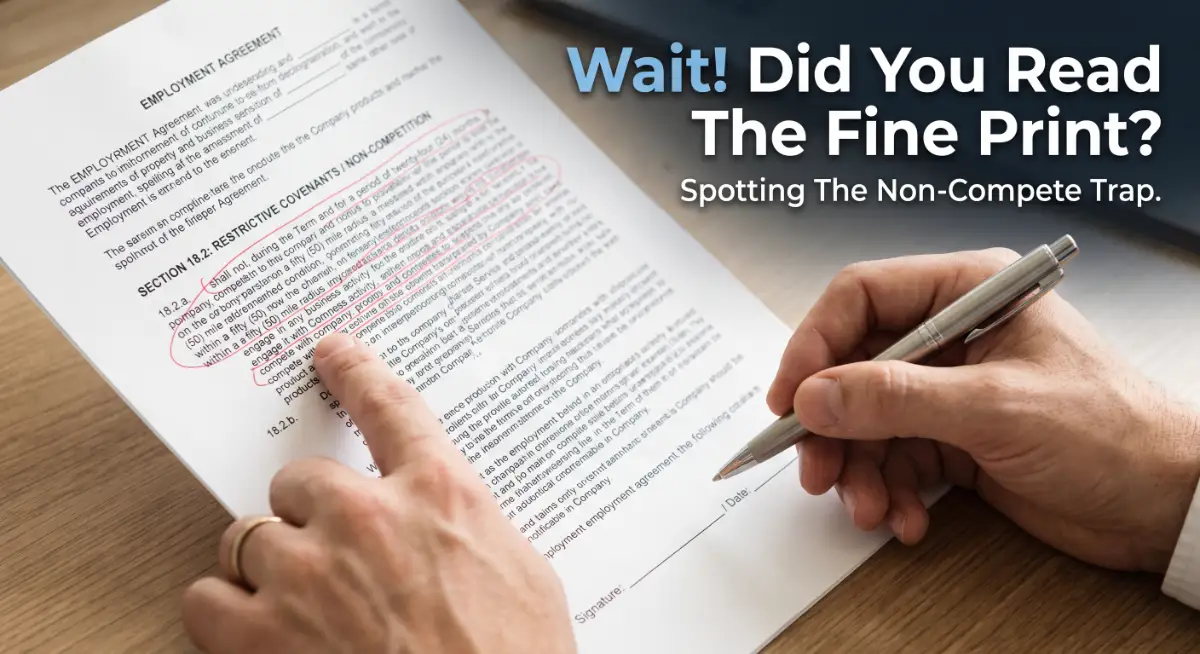
It was a ridiculously broad non-compete clause. According to the document I signed, I was legally blocked from working for any company in the same industry for two whole years.
My heart dropped into my stomach. I was entirely paralyzed by the sudden realization that I had signed away my freedom without even knowing it. My mental peace completely vanished, replaced by heavy anxiety and a feeling of being trapped in a cage.
Every single day, thousands of hardworking professionals make this exact same mistake. We get blinded by the excitement of a new salary or a fancy job title. We assume that HR is looking out for our best interests and that standard contracts are harmless.
This blind trust leads to massive problems in our daily lives. People find themselves stuck in abusive jobs because they cannot afford the legal fight to leave. Others discover that their employer secretly owns all the creative side projects they work on during the weekends.
The stress of feeling trapped ruins your sleep, destroys your weekend joy, and constantly weighs heavily on your shoulders. The sad reality is that a bad contract does not just affect your career. It deeply hurts your family, your financial stability, and your mental health.
Decoding The Sneaky Traps Hiding In Plain Sight
We are going to walk through the exact things you need to look out for when you get that PDF in your inbox. You do not need a law degree to understand this stuff. You just need to know where to look.
Let us explore the most common traps companies use to control their workers. These are the things they hope you will skim over.
The "You Can Never Leave Us" Trap (Non-Compete Clauses)
This is by far the most dangerous part of any modern job offer. Companies love to protect their trade secrets, which is perfectly understandable. But they often go way too far.
Imagine you are a fantastic chef working at a local pizza restaurant. A bad non-compete clause would not just stop you from sharing their secret tomato sauce recipe. It would legally ban you from baking a pizza anywhere within a fifty-mile radius for the next three years.
That is exactly how these clauses work in the corporate world. They use incredibly broad language to restrict your future options. They might say you cannot work for any "competing business."
But how do they define a competing business? If you work in marketing for a software company, does that mean you cannot do marketing for a hospital? Sometimes, the wording is so vague that the company can stretch it to mean whatever they want.
You always have to look at the timeline and the geographic location. A six-month restriction in your specific city might be manageable. A two-year restriction covering the entire country is a massive red flag.
Watch This Quick Breakdown On Handling Unfair Contracts
If you are feeling overwhelmed by complicated legal terms, you are not alone. This short video breaks down the exact steps you need to take when you spot a red flag in your job offer, ensuring you protect your rights without losing the opportunity.
They Want To Own Your Brain (Intellectual Property Theft)
This is a massive issue for creative professionals, software developers, and writers. When you sign on the dotted line, there is usually a section about Intellectual Property (IP).
The standard expectation is that anything you create while at work, using company equipment, belongs to the company. That makes sense. However, many standard agreements try to push this boundary to extreme levels.
A Quick Reality Check:
| The Normal Expectation | The Sneaky Contract Reality |
| The company owns the code you write at your desk during working hours. | The company claims ownership of ANY code you write, even on your personal laptop on a Sunday. |
| The company owns the ad campaigns you design for their clients. | The company demands the rights to the personal travel blog you started three years ago. |
I have seen contracts that state the employer owns every single idea, invention, or creation you come up with during your employment period. They do not care if you did it on your own time, using your own money, in your own garage.
If you are someone who likes to do side hustles, build apps, or write books in your spare time, this clause can completely ruin your life. You could spend months building a successful side business, only for your boss to step in and legally take 100% of the profits.
Always negotiate this section. Ask them to add a simple sentence stating that the company has no rights to anything you create on your own time, without using company resources.
My Personal Pro Tip for Protecting Your Side Hustles
When I finally learned my lesson, I started keeping a highly detailed record of my side projects before joining any new company. I actually list out my existing personal projects on a separate piece of paper, attach it to the back of the agreement, and make HR sign it. It completely separates my personal business from my day job and gives me total peace of mind.
The "We Can Fire You For Breathing" Section (Termination Clauses)
Nobody likes to think about getting fired when they are accepting a brand new job. It feels like planning a divorce on your wedding day. But this is exactly when you need to protect yourself the most.
You will usually see two types of firing mentioned in the document. Firing "for cause" and firing "without cause." Understanding the difference between these two is extremely important.
Termination "for cause" means you did something terribly wrong. You stole money, you harassed a coworker, or you completely stopped showing up. If you are fired for cause, you usually get zero severance money.
The problem is how the company defines "cause." Some sneaky contracts list things like "failure to meet management expectations." That is dangerously vague.
If your boss simply does not like you, they can claim you did not meet their completely unrealistic expectations. Suddenly, you are fired for cause and left with empty pockets.

You need the definition of "cause" to be highly specific. It should only cover serious misconduct or illegal activities.
Quick Reality Check:
- Myth: "Termination for cause" only happens if I steal from the company or break the law.
- Fact: If your contract doesn't define it clearly, a sneaky employer can use "poor performance" as a cause to fire you without paying any severance. Always get it strictly defined in writing!
The Silent Schedule Destroyer (Duties and Responsibilities)
Look closely at the section describing your role. Almost every single time, you will see a tiny phrase tacked onto the very end. It usually says something like, "and other duties as assigned by management."
That single sentence is a blank check for your boss to completely change your job description. You might get hired to be a graphic designer. Six months later, your boss demands that you also handle customer support calls and manage the office payroll.
When you complain that this is not what you signed up for, they will simply point to that one little sentence. They legally have the right to force you into doing three jobs for the price of one.
To protect your sanity, you can politely ask them to change the wording. Ask them to write "and other reasonable duties closely related to the core role." This tiny change stops them from turning you into their personal assistant.
Quick Summary: Before You Sign
- Don't let a friendly interview stop you from reading the strict fine print.
- Make sure "termination for cause" is strictly limited to illegal acts or serious misconduct.
- Watch out for forced arbitration—it takes away your right to defend yourself in a real court.
- Clarify exactly who owns your weekend side hustles to protect your personal projects.
Giving Up Your Right To A Fair Fight (Forced Arbitration)
This is perhaps the most invisible trap of all. It sounds incredibly boring, so people just skip right past it. But it is a massive deal for your basic human rights.
If a company does something horribly wrong to you, like stealing your unpaid wages or discriminating against you, your first instinct might be to take them to court. You want a judge and a jury to hear your story.
A forced arbitration clause completely strips that right away from you. By signing it, you agree that you will never sue the company in a real public court.
How to Push Back (Copy & Paste Script):
Not sure how to fight a forced arbitration clause without sounding rude? Try sending a polite email like this:
"Hi [Manager's Name], I am so excited to join the team! Before I sign, I noticed the mandatory arbitration clause. Is there any flexibility to opt out of this specific section while keeping the rest of the agreement exactly as is?"
Instead, you have to take your complaint to a private arbitrator. Who pays for this private arbitrator? Usually, the company does.
This creates a massive conflict of interest. The arbitrator wants to keep getting hired by the big company, so they are naturally more likely to side with your employer. The meetings are completely private, meaning the company avoids any bad public relations.
You are forced to fight a massive corporation in a secret room, often without a jury, and the decision is usually final. You cannot even appeal it if you lose.
While it is very hard to get a company to remove this clause completely, you must at least be aware of what you are giving up. It changes the entire dynamic of your working relationship.
Busting Common Myths About Negotiating Your Offer
People are terrified of speaking up. We convince ourselves that asking questions will automatically ruin our chances. Let us clear up some of the biggest misunderstandings right now.
Myth: If I ask them to change a word in the document, they will immediately take back the job offer.
Reality: Hiring you takes a massive amount of time and money. By the time they send you the offer, they really want you. Asking polite, professional questions about a legal document shows that you are smart and detail-oriented. They will respect you more for it.
Myth: The HR department wrote this specific document just for me, so it cannot be changed.
Reality: HR almost never writes these from scratch. They use a standard copy-and-paste template for every single employee. Half the time, the HR person sending it to you does not even know what the fine print actually means.
Myth: I am just a junior employee, so I have absolutely zero power to negotiate anything.
Reality: You always have power. Even if they refuse to change the main text, you can ask for a side letter. A side letter is a simple email from HR clarifying how a specific rule will be applied to you. That email becomes part of your legal agreement.
Whenever you feel scared to push back, remember the pain of being stuck. A five-minute uncomfortable conversation today can save you two years of absolute misery later.
Take a deep breath, grab a cup of coffee, and start reading every single line. Highlight anything that sounds confusing, vague, or overly aggressive. Your career is your biggest financial asset. You need to protect it like a fortress.
Taking Back Control: How To Push Back Like A Pro
Now that you know exactly what kind of sneaky traps are hiding in those PDF files, it is time to talk about taking action. Spotting the problem is only the first half of the battle.
The real magic happens when you know how to safely and professionally push back against an unfair document. Most people freeze up at this stage because they are terrified of losing the job offer entirely.
Let me show you a completely different approach. Negotiating your terms does not mean you have to be aggressive, loud, or angry. It simply means you are stepping into a business relationship as an equal partner.
Phase One: The Forty-Eight-Hour Rule
The absolute worst time to read a legal document is right after you receive it. Your brain is swimming in happy dopamine because you just got a new job. You are highly likely to ignore obvious warning signs just to keep that happy feeling alive.
Always politely ask for at least forty-eight hours to review the document. A simple email saying, "I am thrilled about this offer and look forward to reading through the details over the next two days," sets a perfect professional boundary.
If a company tries to force you into signing a twenty-page legal document in three hours, that is a massive red flag. Good employers respect your need to make informed decisions about your future.
Phase Two: Building Your Translation Glossary
Lawyers use a very specific type of language designed to protect the company at all costs. You need to learn how to translate their fancy words into everyday reality.
Whenever you see the phrase "at the sole discretion of the company," you should immediately pay attention. This simply means the company can do whatever they want, whenever they want, without asking your permission.
If they apply this phrase to your bonus structure or your work location, you have a problem. They are legally saying they can cancel your yearly bonus or force you to move to a different city without any warning.
Another highly dangerous phrase is "in perpetuity." This means forever. If an agreement says the company owns the rights to your likeness or creative ideas "in perpetuity," they own it until the end of time, long after you stop working there.
Always look up understanding basic federal worker rights to see how your specific location handles these permanent claims. Some regions completely ban companies from owning your ideas forever, while others allow it entirely.
Phase Three: The Friendly Email Strategy
You do not need to hire an expensive lawyer to cross out words in red ink. You can simply send a very polite, bulleted email to the HR manager.
Start the email with extreme positivity. Remind them how excited you are to start working with the team. Then, frame your concerns as simple requests for clarification.
Instead of saying, "Your non-compete clause is ridiculous and I will not sign it," try a softer approach. Say, "I noticed the non-compete covers a fifty-mile radius for two years. Could we reduce this to six months to better reflect standard industry practices?"
This friendly tone makes it incredibly hard for them to get defensive. You are not attacking their document; you are simply asking for a tiny adjustment to protect yourself.
Creating A Bulletproof Paper Trail
Sometimes, HR will call you on the phone and say, "Do not worry about that scary clause; we never actually enforce it against our employees."
This is a classic trap. If they never enforce it, they should have absolutely no problem removing it from the document. A verbal promise over the phone means absolutely nothing in a courtroom.
If you want to properly protect your assets legally, every single promise needs to be written down. If they refuse to change the main document, ask for a side letter.
A side letter is just a formal email from the company stating how a specific rule will apply to you. You can save this email and use it as evidence if things go wrong later. Keeping perfect records of your communications is your strongest defense against corporate amnesia.

The Silent Pitfalls That Can Destroy Your Leverage
Even smart, highly educated professionals fall into the same predictable traps during the hiring process. The excitement of a new salary often makes people completely ignore basic common sense.
Let us walk through the most dangerous mistakes people make when staring at a signature line. Avoiding these common errors will save you massive amounts of stress and money down the road.
Falling For The "Family Culture" Illusion
You just finished your final interview. The hiring manager took you out for lunch, told you funny stories, and said, "We treat everyone like family here."
It feels amazing to hear that. But you have to remember that a business is a business. When profits drop, that "family" will not hesitate to cut your position to save their bottom line.
When your friendly boss leaves, a new, strict manager might replace them. That new manager will only care about what is written on your signed agreement, not the nice promises you were told over lunch.
Ignoring The "Severability" Clause
Way down at the very bottom of the document, usually hidden in the final paragraph, you will find something called the severability clause. It looks incredibly boring, so most people skip it entirely.
People often think, "Well, my state banned non-competes, so this whole contract is garbage anyway." That is completely wrong.
A severability clause basically states that if a judge finds one specific rule in the document to be illegal, the rest of the contract remains 100% active and powerful. To truly grasp how severability clauses actually work, you must understand that the company is legally protecting its own document from falling apart.
If they include an illegal rule, only that single sentence gets crossed out. You are still fully bound to the forced arbitration, the intellectual property theft, and the bad termination rules.
Assuming You Are Completely Powerless
This is the most heartbreaking mistake of all. Many younger workers, or those desperate for a job, believe they have zero power to change anything.
They adopt a mindset of complete submission. They think that because they rely entirely on a single income stream, they have to accept every single toxic rule the company demands.
While it is true that big companies have more resources, you have something they desperately want: your skills. Hiring is an exhausting, highly expensive process for a company.
Once they send you the official offer, they have already rejected all the other candidates. They want you. They do not want to start the painful interview process all over again just because you asked to tweak one sentence about working weekends.
Skipping The Benefits Fine Print
Everyone looks at the base salary, but very few people read the complex rules surrounding their company benefits. They just assume standard healthcare and standard vacation days will naturally apply.
You need to actively spend time understanding complex company benefits before you sign. Does your paid time off roll over into the next year, or does it disappear if you do not use it?
If you quit your job, does the company legally owe you money for your unused vacation days? Many bad agreements explicitly state that you forfeit all unused time if you resign voluntarily. That is literally thousands of dollars of your hard-earned money just vanishing into thin air.
Walking Into Private Rooms Blindfolded
We talked earlier about forced arbitration. The mistake people make here is not just signing it but completely misunderstanding what it means for their daily life.
When you agree to step into a private legal meeting instead of a public courtroom, you lose your biggest weapon: public pressure.
Companies behave much better when they know a local newspaper might write a story about their bad behavior. Arbitration strips away the threat of bad PR. If things get complicated, you might eventually need help finding a qualified worker's advocate who specifically understands how to navigate these private company courts.
Always check if you have the option to "opt-out" of the arbitration clause. Some companies hide a tiny rule saying you can send an email within thirty days of joining to reject the arbitration agreement. If you see that window, take it immediately.
Your Action Plan For A Secure Future
You are no longer a victim waiting to fall into a corporate trap. You now have the exact knowledge and tools needed to protect your time, your money, and your mental health.
Handling an employment document is actually quite simple once you remove the fear from the equation. It is just a piece of paper. You are simply having a conversation about how you and the company will work together.
The Pre-Signature Checklist
Before you ever pick up a pen or click that digital signature button again, walk yourself through this quick mental checklist.
First, identify the non-compete boundaries. Write down exactly how many months it lasts and the physical distance it covers. If it feels too broad, prepare a polite email asking for a reduction. You can always check trusted resources on navigating unfair non-compete agreements to see what is normal in your area.

Second, secure your side projects. Make absolutely sure the document clearly separates your weekend hobbies and personal businesses from company property.
Third, clarify your exit strategy. Ensure that you know exactly what happens to your unused vacation pay and severance if the relationship suddenly ends. Having a secure financial safety net makes this conversation much less scary.
When you treat your career like a serious business, employers will instantly treat you with far more respect. You set the tone for your entire working relationship before your first day even begins.
What Others Are Asking About Job Agreements
Can an employer take back the job offer if I try to negotiate?
Yes, technically they have the legal right to pull the offer at any time before it is finalized. However, in the real world, this is extremely rare if you remain polite and professional. Most normal companies expect some level of friendly back-and-forth regarding legal terms and salary.
Do I really need to hire a lawyer to read my offer?
For an entry-level or mid-level position, you usually do not need a lawyer if you understand the basic red flags mentioned above. However, if you are accepting a high-level executive role with complex stock options, spending a few hundred dollars on a professional review is an incredibly smart investment.
Are non-compete rules actually enforced in real life?
Yes, they absolutely can be. While some regions are starting to ban them completely, many traditional companies will still send aggressive letters to your new boss if they think you broke the rules. Never sign one assuming the company will just ignore it later.
What happens if I cross out a sentence with a pen before signing?
If you cross something out manually and the company does not notice or sign next to your change, it can create a messy legal grey area. It is always much better to ask HR for a freshly typed, updated digital document so everyone is on the same page.
Is a verbal promise from a manager legally binding?
Almost never. Most modern documents contain an "entire agreement" clause, which specifically states that any verbal promises made before signing mean absolutely nothing. If your manager promises you something great, you must politely ask them to type it into the actual document.
A Final Thought From My Desk
I truly want you to look at your next job offer not as a final demand, but as the starting line of a great conversation. My biggest regret was letting fear rush me into a bad signature, and I promise you will feel incredibly empowered the moment you start asking the right questions. Take a deep breath, trust your worth, and never be afraid to politely demand the respect your career deserves.
Disclaimer: The information provided in this blog post is for educational and informational purposes only and does not constitute legal, financial, or professional advice. Employment laws vary significantly by region and individual circumstances. Always consult with a qualified employment attorney or legal professional in your specific jurisdiction before making any decisions regarding contracts, negotiations, or workplace disputes.
![The Secret to Winning Your Minor Car Accident Claim [Step-by-Step]](https://fintiq24.com/storage/uploads/blogs/1787855377_the-secret-to-winning-your-minor-car-accident-claim-step-by-step.webp)
![Hidden Secrets of Intellectual Property Law [Step-by-Step]](https://fintiq24.com/storage/uploads/blogs/1787850988_hidden-secrets-of-intellectual-property-law-step-by-step.webp)
![Warning: Read This Before Your First Mediation Session [Expert Advice]](https://fintiq24.com/storage/uploads/blogs/1787821498_warning-read-this-before-your-first-mediation-session-expert-advice.webp)