Facing the Hidden Nightmare of Local Property Rules
Quick Summary: What You Will Learn in 3 Minutes
- The Alphabet Soup: How to decode zoning codes (like R-1 and C-2) so you know exactly what a piece of land is built for.
- Hidden Boundaries: Why invisible rules like setbacks and floor area ratios (FAR) can legally force you to tear down your own renovations.
- The GIS Secret: How to use free city mapping tools to spot a property's true potential before you sign any mortgage paperwork.
- Permit Lifesavers: Why befriending your local city planner is the absolute best investment for your peace of mind.
Ever bought a piece of land thinking, 'I own this; I can do whatever I want with it'? Yeah, me too. Then reality hit me in the form of a 200-page city zoning manual. Property zoning rules might look like a foreign language designed to crush your backyard renovation dreams, but they do not have to be. Let me walk you through exactly how I stopped paying silly planning fines and learned to read city property maps like a pro—no legal degree required.
That single, innocent mistake cost me thousands of dollars in wasted planning fees and months of endless emotional stress. I felt completely defeated, wondering why a piece of private land that I legally owned came with so many invisible restrictions. I felt like the city was actively working against my family. It was a very harsh awakening to how confusing and unforgiving the real estate world actually is.
Everyday people face this exact same frustration when they try to make basic changes to their own property. You buy a home thinking you have total freedom and complete control over your personal space. Then, you suddenly find out you cannot even build a wooden fence above a certain height, let alone start a quiet home-based business.
Real estate ownership should bring you a sense of deep security, not a constant, lingering fear of accidentally stepping over an invisible regulatory line. When you do not clearly understand what your land is actually zoned for, every single renovation idea feels like a massive financial risk. This emotional toll is incredibly exhausting for regular, hardworking people who just want to improve their daily living situations.

Breaking Down the Invisible Boundaries of Your Land
To truly solve this frustrating problem, we first need to look at local property rules through a completely different lens. Think of your city or town exactly like a massive, well-organized kitchen. You would never store your raw chicken right next to your fresh baking flour, right?
Local governments use a very similar logic when they plan out city neighborhoods and streets. They want to keep noisy, smelly factories far away from quiet, peaceful neighborhood bedrooms. This basic idea of separating different types of daily activities is the entire foundation of property zoning.
When you understand this core logic, the heavily worded legal documents suddenly start making a lot of sense. Instead of viewing these rules as arbitrary punishments, you can start seeing them as the instruction manual for your neighborhood.
Let us look at some highly practical steps to decode these invisible boundaries so you can take back control of your property rights. By following a logical approach, you can completely avoid the painful financial mistakes that trap so many new buyers.
Grasping the Main Categories of Real Estate
The absolute first thing you must do is learn the primary buckets that cities use to categorize raw land. Every single piece of dirt in your city falls into one of these specific buckets.
Zoning Reality Check: What You Think vs. What Is
- Myth: "I can run my online business from my residential garage without asking anyone."
- Reality: Even quiet home businesses often need a "Home Occupation Permit" to avoid neighbor complaints and sudden city fines.
- Myth: "If the land is empty, I can build a duplex."
- Reality: Empty land usually has strict "Single-Family Only" (R-1) rules. Building a duplex requires an R-2 or R-3 designation.
Residential Areas: This is where people sleep, live, and raise their families. These areas are strictly protected against high traffic, loud noises, and large commercial operations. If you buy a house here, you can usually build a deck, add a swimming pool, or plant a big garden. But you definitely cannot open a noisy auto repair shop in your driveway.
Commercial Zones: This bucket is designed entirely for conducting business and making money. Think of your local shopping malls, busy coffee shops, and massive grocery stores. The rules here focus heavily on customer parking spaces, large neon signs, and public safety access. Buying land here is great for profit, but the city will likely never let you build a quiet family cabin on a commercial lot.
Industrial Spaces: These areas are the loud, messy engines that keep a city running smoothly. Factories, massive shipping warehouses, and chemical plants belong here. You will almost never see schools or homes near these areas because of the heavy truck traffic and potential pollution.
The Real-Life Impact of Misunderstanding Categories
Let us look at a highly practical scenario to show why knowing these categories matters so much. Imagine you want to buy a beautiful old Victorian house on a busy street corner to turn into a charming bed and breakfast.
You excitedly purchase the property, assuming that because it looks like a house, you can sleep guests there. However, upon checking the local records, you discover the property is strictly zoned for single-family residential use only.
Because a bed and breakfast is legally considered a commercial business, the city violently shuts down your operation before you even open your doors. You are now stuck with a massive mortgage and a business plan you cannot legally execute.
If you are still struggling to visualize how these maps work, watching a real-time walkthrough can instantly clear up your confusion.
This exact nightmare scenario happens constantly to overly eager investors who skip their basic homework. You must legally verify the permitted use of a building, regardless of what the building currently looks like on the outside.
I learned this lesson the hard way during my early days of property hunting. I once found a cheap plot of land and assumed I could just build whatever I wanted because it was empty.
My real estate agent had to pull me aside and gently explain that the land was zoned specifically for agricultural use. If I had bought it without checking, my dream of building a modern duplex would have been completely crushed by the local farming commission.
How to Actually Read a City Planning Map
Now that you know the basic categories, you need to know how to locate and read your local city map. Almost every single local government now hosts their official zoning maps online for free.
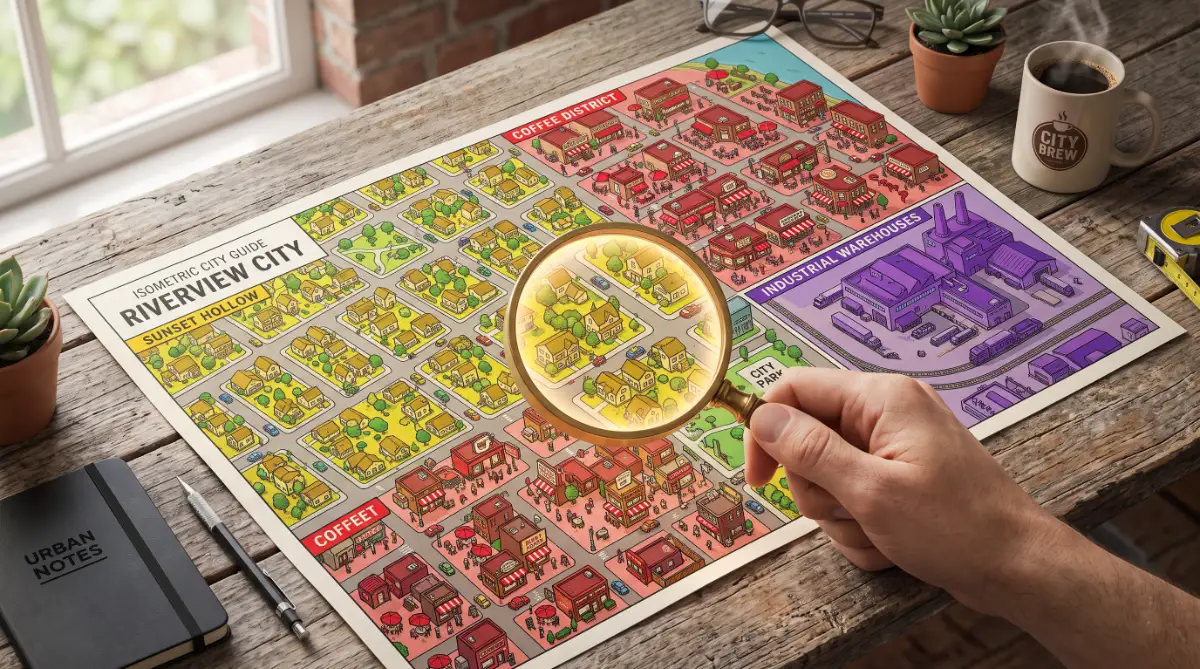
You can simply go to your local city government website and search for the planning or building department section. Once you open the map, it will look like a wildly colorful patchwork quilt. Do not let the intense mess of colors intimidate you.
These colors are just a universal visual shortcut for the categories we just discussed. Generally, yellow or light green represents residential neighborhoods where families live. Red usually marks the busy commercial districts with retail stores and offices. Purple or dark grey almost always indicates heavy industrial manufacturing zones.
Decoding the Alphabet Soup of Local Codes
When you click on a specific colorful parcel of land on that digital map, you will see a strange combination of letters and numbers. You might see something like "R-1" or "C-2" floating over your street.
These small abbreviations are the actual legal codes that dictate your property rights. The letter always stands for the broad category, while the number represents the intensity of how that land can be used.
If your home is in an R-1 district, the city only wants one family living on that specific piece of land. If you try to illegally convert your basement into a separate rental apartment, neighbors will eventually complain. The city will then send an inspector, and you will be forced to rip out your expensive new kitchen.
Understanding this alphabet soup is your absolute best defense against making a terrible real estate investment. It tells you exactly what the city envisions for the future of your specific street.
Uncovering the Hidden Rules Within the Rules
Finding out you are in a residential zone is only the very first piece of the puzzle. Within these broad categories, there are extremely specific micro-rules that govern the physical shape of your buildings.
One of the most common hidden rules is called a setback requirement. A setback is the legally required invisible distance between your physical building and your property line.
For example, your city might require a 20-foot setback from the front sidewalk and a 10-foot setback from your neighbor's yard. If you try to build a massive front porch that crosses into that 20-foot invisible zone, the city will literally force you to tear it down.

Another highly confusing hidden rule is the Floor Area Ratio (FAR). This specific mathematical rule dictates exactly how large your house can be compared to the size of your raw dirt lot.
If you own a 10,000-square-foot lot with a FAR of 0.5, the total square footage of your house cannot exceed 5,000 square feet. This rule exists purely to stop wealthy developers from building massive, ugly mansions on tiny neighborhood lots and blocking everyone else's sunlight.
Your Pre-Purchase Zoning Checklist (Do not skip this!)
- Check the Floor Area Ratio (FAR): Can you actually build the total square footage you want?
- Measure the Setbacks: Does your dream deck cross into the city's invisible 20-foot boundary?
- Verify Existing Structures: Did the previous owner pull legal permits for that finished basement? If not, the legal liability is entirely on you!
Debunking Common Myths About Land Ownership
There is so much terrible advice floating around the internet regarding what you can and cannot do with land. To protect your mental health and your wallet, we need to completely destroy some of these common myths.
Myth 1: If I own the land, I can build exactly what I want.
This is easily the most dangerous belief in real estate. Buying property only gives you the legal right to use the land within the boundaries set by the local government. You are essentially buying a puzzle piece, and the city dictates exactly how that piece fits into the larger neighborhood picture.
Myth 2: Existing buildings are always perfectly legal.
Never assume a building is legal just because it has been standing there for twenty years. Previous owners frequently build unpermitted additions, extra bedrooms, or illegal backyard sheds in the dark of night. If you buy a property with illegal additions, the legal responsibility and the massive fines instantly transfer to you upon closing.
Myth 3: The city will never actually find out about my small project.
In the modern age of digital satellite imaging and nosy neighborhood apps, your secret project will absolutely be discovered. City planners now use automated drone software and aerial photos to spot illegal structures being built in backyards. Trying to hide an illegal renovation is a massive gamble that almost always ends in severe financial pain.
What Happens When Your Dream Conflicts With the Law?
Sometimes, you might have a truly amazing vision for a property that technically violates the current legal codes. Maybe you want to build your garage just two feet closer to the property line than the rules allow.
When your plans slightly break the rules, you do not always have to completely give up on your dream. You can actually ask the local government for a legal exception, which is officially called a zoning variance.
Applying for a variance means you are publicly asking the city to bend their rules specifically for your unique situation. You usually have to prove that following the strict rules would cause you an unfair physical hardship based on how your land is shaped.
However, getting a variance approved is incredibly difficult and involves attending public city council meetings. Your neighbors will get an official letter in the mail, and they can actually show up to the meeting to publicly argue against your project.
If your neighbors complain that your new garage will block their afternoon sunlight, the city council will almost certainly reject your variance request. This is exactly why maintaining a friendly, positive relationship with your next-door neighbors is a hidden superpower in real estate investing.
The entire process of understanding these legal boundaries takes a lot of deep patience and careful reading. But taking the time to learn these concepts will ultimately save you from the devastating heartbreak of a failed property project.
Taking Full Control of Your Property Blueprint (Advanced Secrets)
Once you understand the basic categories of land use, you are ready to step into the big leagues of real estate planning. You do not have to be a highly paid lawyer to master these local government rules. You just need to know exactly where to look and who to talk to before you spend any money.
One of the best-kept secrets in real estate is a digital tool called a Geographic Information System. Most local governments use a public GIS mapping portal to track every single detail about town properties. This tool is completely free to use and provides way more information than a standard paper map.
When you type your street address into the local GIS system, you unlock a treasure trove of hidden data. You can instantly see your exact property lines, flood zones, and historical building permits. It perfectly shows you where the city sewer lines run and if there are any protected environmental areas on your raw dirt.
Another incredible expert strategy involves completely changing how you view the local city planner. Most normal folks see city officials as strict traffic cops whose only job is to say no to fun projects. But if you walk into the planning office with a friendly smile and a rough sketch, they become your absolute best teammates.
City planners actually love it when homeowners ask for advice before starting construction. You can simply walk up to the front desk and say you want to improve your property while strictly following their rules. By involving them early, they will personally point out potential legal hurdles and suggest affordable workarounds.
You also need to fully understand the magic concept of a "grandfathered" property rule. Sometimes, a city will completely change the official zoning rules for an entire neighborhood overnight. For example, they might decide that your street is now strictly residential, even though you have run a legal corner store there for a decade.
When this happens, your existing business usually becomes a legal non-conforming use. This basically means you are legally grandfathered in and can keep operating your business because you were there first. However, if your building ever burns down or you close the shop for an extended period, you instantly lose that special legal protection.
Understanding these historical protections is a massive advantage when you are buying older buildings. You can actually protect your assets legally by proving your property had a specific use long before the new neighborhood rules were invented. Always check the dusty historical archives at the county office to confirm what previous owners did legally.
If you are thinking about starting a small home-based business, you must learn about home occupation rules. Cities know that modern internet businesses operate very differently than loud, messy factories. Many towns now have special, relaxed rules for quiet home offices or remote consulting businesses.
The main trick here is proving to the city that your home business will not bother your immediate neighbors. As long as you do not have massive delivery trucks arriving daily or loud machinery running at night, they usually approve it quickly. You just need to read the specific Home Occupation checklist provided by your local town hall.
Always treat your real estate research just like you would treat reading a complicated employment contract. Just as you want to avoid the hidden traps in your job offer, you must carefully review every single line of a property title. Looking closely at these documents reveals hidden easements, which are special rights allowing utility companies to legally dig up your front yard.

The Financial Traps Most Property Buyers Fall Into
Trying to navigate local real estate rules without a clear plan often leads to terrifying financial disasters. I have watched excited, hopeful families lose their entire life savings simply because they trusted the wrong advice. The absolute biggest mistake you can make is relying on the friendly neighborhood gossip instead of checking official records.
Imagine asking your next-door neighbor if it is okay to build a large wooden fence between your yards. Your neighbor might happily agree, and you seal the deal with a firm handshake and a smile. You then spend thousands of dollars on expensive lumber and professional labor to build a beautiful ten-foot privacy fence.
Two weeks later, an angry city inspector aggressively knocks on your front door with an official clipboard. They hand you a massive fine and a strict legal order to tear down the entire fence by Friday. You just learned the hard way that a friendly handshake agreement does not override the strict local guidelines for residential structures.
Another devastating trap happens when buyers completely ignore unpermitted additions made by the previous homeowner. Let us say you buy a gorgeous house that features a fully finished basement with a second kitchen. You are thrilled because you plan to rent out that basement to help pay down your expensive monthly mortgage.
However, you never bothered to check if the previous owner actually pulled legal permits for that extra kitchen. The city eventually finds out about the illegal construction and holds you entirely responsible as the current legal owner. You are suddenly forced to rip out the beautiful cabinets and plumbing at your own personal expense.
When you get hit with unexpected demolition costs and heavy government fines, it completely drains your bank account. This is exactly why you must build an emergency fund fast before you ever decide to purchase any real estate. You need a massive cash buffer to instantly handle these surprise regulatory nightmares without going deeply into personal debt.
People also frequently confuse strict city rules with the private rules created by a Homeowners Association (HOA). Just because the city legally allows you to paint your house bright purple does not mean your HOA will allow it. Your neighborhood HOA can actually enforce private design rules that are way stricter than the local government laws.
Ignoring HOA letters or fighting with angry neighbors over property lines always leads to horrible emotional stress. Before things escalate into a massive lawsuit, you might need to schedule a first mediation session to calm everyone down. Always remember that maintaining a peaceful, friendly relationship with your community is just as important as following the law.
Finally, do not ever fall into the trap of thinking that vacant land is a totally blank canvas. Many eager investors buy cheap, empty lots in the middle of nowhere, assuming they can build a massive storage facility. They fail to realize that the land sits on a protected natural wetland, meaning absolutely zero construction is legally allowed.
When you borrow money from a strict bank to fund a doomed project, the financial pressure becomes unbearable. The heavy psychology of borrowing money combined with a rejected building permit can destroy your mental health. Always secure your local permits before you ever sign a massive loan document with a traditional bank.
Your Master Plan for Real Estate Peace of Mind
Navigating the hidden maze of local property rules does not have to be a terrifying, anxiety-inducing experience. Once you learn how to properly read the colorful city maps and decode the alphabet soup, you take your power back. You transform from a confused, nervous buyer into a highly educated and confident property owner.
The secret to long-term success is treating your local government office as a valuable educational resource. Build a genuine, friendly relationship with the hardworking clerks who sit behind the planning desk. When you show them true respect and a willingness to learn, they will happily guide you away from very costly mistakes.
Always demand cold, hard-written proof for every single claim made by a real estate agent or a seller. If they promise you can build a massive swimming pool in the backyard, tell them to show you the official survey map. Taking just an extra hour to verify these specific claims will literally save you years of legal headaches.
It is incredibly important to view these neighborhood regulations as tools that actually protect your long-term property value. Yes, they stop you from building whatever you want, but they also stop your neighbor from opening a noisy nightclub. These rules ensure that your quiet residential street remains a safe, peaceful place for your family to sleep at night.
I honestly wish someone had handed me a simple, practical guide like this when I first started my real estate journey. My biggest hope is that you use this knowledge to completely protect your hard-earned investments and finally build the peaceful home of your dreams.
The Most Asked Questions About Real Estate Rules
Can I legally change the zoning category of my property?
Yes, it is definitely possible to request a total category change, which is known as rezoning. However, it is an extremely long, expensive process that requires official public hearings and city council approval. You must prove to the government that the change will significantly benefit the surrounding neighborhood.
What exactly happens if I just ignore the local property rules?
If you completely ignore the rules, the city will heavily fine you for every single day the violation exists. They can place a massive legal lien on your house, making it entirely impossible to sell the property later. In extreme cases, they will force you to physically tear down the illegal structure at your own expense.
Does my local town government regulate small backyard sheds?
Almost every single town regulates backyard structures, even if they seem incredibly small and harmless. They usually dictate exactly how close the shed can sit to your neighbor's fence and how tall the roof can be. Always call the local permit office before you spend any money at the hardware store.
How long does it take to get a special variance approved?
Getting a special variance approved usually takes anywhere from a few weeks to several very stressful months. It entirely depends on how busy your local planning office is and how complicated your specific project happens to be. You should always expect delays and factor that extra waiting time into your construction schedule.
Will my property taxes increase if I get an official building permit?
Yes, legally upgrading your home with official permits almost always increases the overall assessed value of your property. When your official home value goes up, your yearly property tax bill will naturally increase as well. This is a normal part of real estate ownership and shows that your smart investment is actually growing in value.
Disclaimer: This article is for informational and educational purposes only and does not constitute official legal, financial, or real estate advice. Property rules vary wildly by specific local jurisdiction. Always consult with a licensed real estate attorney or your local municipal planning office before making any major financial decisions or starting construction on your property.

![Secret Mortgage Pre-Approval Rules the Banks Never Tell You[Step-by-Step]](https://fintiq24.com/storage/uploads/blogs/1788379410_secret-mortgage-pre-approval-rules-the-banks-never-tell-youstep-by-step.webp)